Tuesday, December 7, 2010

PURE WHITE TIGER AND PURE BLACK TIGER

Lairweb.org
wikepedia.org 


You will, however, find tigers which are very close to being pure white, but these still have some areas of very faint striping and colour to be found on the lips, nose and paw pads; this means they are not albino animals. Though there is no reason albinism cannot occur within tigers, experts who have been consulted have all stated they have yet to sight a true albino. 


 Black tigers do not exist.


 Yes, they do! Well, they have done. We now have photographic evidence of this colouration occurring, at least in Bengals. It is a simple case of melanism. This means there is an abnormally high amount of dark pigment in the coat. It is also melanism which causes black jaguars and leopards, often termed black panthers.

A black tiger is a rare color variant of the tiger and is not a distinct speices or geographic  There subspecies are reports and one painting (now lost) of pure black non-striped tigers (true melanistic  tigers). Most black mammals are due to the non-agouti mutation. Agouti refers to the ticking of each individual hair. In certain light, the pattern still shows up because the background color is less dense than the color of the markings.


So-called black tigers are due to pseudo-melanism Pseudo-melanistic tigers have thick stripes so close together that the tawny background is barely visible between stripes. Such tigers are said to be getting more common due to imbreeding. They are also said to be smaller than normal tigers, perhaps also due to inbreeding or because large black leopards are misidentified as black tigers. A discussion of black tigers was presented by British cryptozoologist Dr Karl Shueker in his book Mystery Cats of the World.

White tiger pictures


Pictures of Tigers


White tigers

White tigers

    The white tiger (also known as the Bengal tiger) is about 3 meters long, and weighs approximately 180-285 kg (400-569 LB). It’s coat lies flatter than that of the Siberian tiger,
the tawny color is richer and the stripes are darker. White tigers are white colored bengals, they are not albinos and they are not a separate subspecies of tigers.

They have blue eyes, a pink nose, and creamy white furr covered with chocolate colored stripes. White tigers are born to tigers that carry the unusual gene needed for white coloring. Wild white tigers are rare species.

The white color of white tigers can be attributed to a special pair of recessive genes on their chromosomes.

White Tigers have become quite common in Zoo's in the United States, Europe and Asia. This is due to a single white tiger imported from India. Since then especially private people and a few Zoo's have done a lot of breeding - and inbreeding - to promote the gene with the White Color.
They've even mixed White Bengal Tigers with the larger Siberian Tigers to get larger specimens to attract more people to see them.

Inbreeding leads to an increased homozygosity among those individuals affected by it which is harmful to them. Typically inbreeding leads to more unfit individuals. In the case of tigers this is that individuals are much worse at doing things normal (not inbreed) tigers are capable of.

Bengal tigers

Bengal tigers


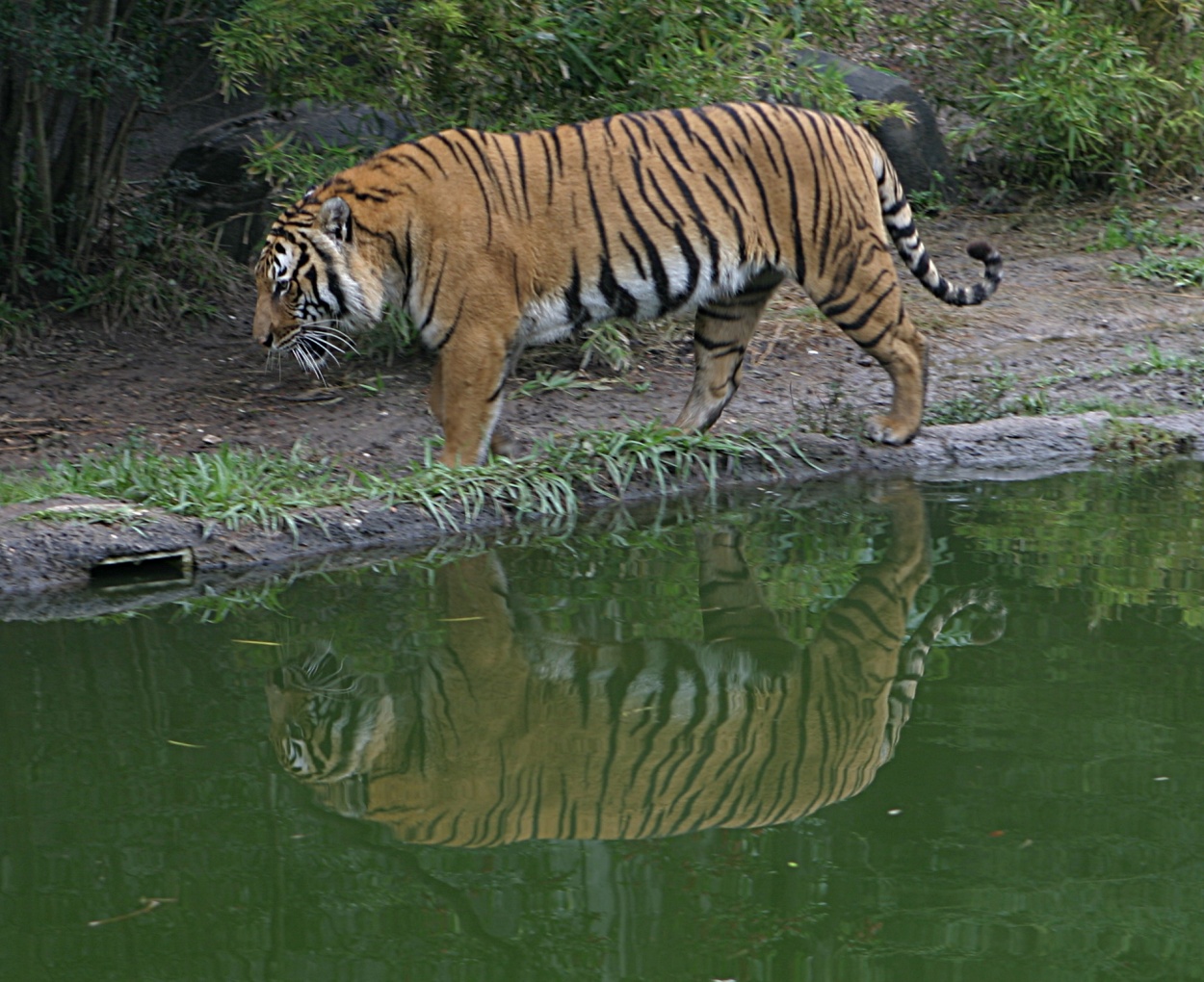
Powerful and stealthy, the Bengal  tiger is the largest and heaviest of the cat family and much feared by other animals and humans alike. With the classic orange and black tiger’s coat, it patrols its own territory and usually hunts alone, stalking its prey or killing it by ambush. Immensely strong, it can bring down animals much larger than itself. Once common throughout Asia, the Bengal tiger is now restricted to small areas of India and the surrounding countries.

The number of Bengal tigers left in the wild has shrunk from 100,000 to about 4,000 over the last century. The main threats are loss of habitat, poaching, loss of prey and the trade in tiger parts for Eastern medicines. Most Bengal tigers now live in protected areas of India. Anti-poaching task forces have been set up and there is also a trade ban on tiger products in many countries.

The white spots behind its ears help other tigers to identify it in the gloom of the jungle, while its heavily muscled shoulders and front limbs are designed for maximum power to pull down prey.

An average male Bengal tigers weigh around 420 pounds. The Bengal tiger has a body length of 6 feet and a tail length of 3 feet and therefore has a total length of 9 feet long. A female Bengal tiger is only 310 pounds and 8 feet long including tail. Bengal tigers are incredibly strong and are able to drag their prey almost half a mile even though the prey may be heavier than itself.

A tigers coat can actually take on a variety of colours. The standard colours of a Bengal tiger are an orange body with black stripes coming down the sides. The two most common variations are the White Bengal tiger and the Golden Tabby.

Bengal tigers have the longest canine teeth of any living felid measuring approximately 4 inches (100 millimetres) in large individuals. A canine tooth of a tiger is larger and longer than that of a similar-sized lion. Bengal tigers also have large, retractable claws that allow them to climb and kill prey. Their stripes help them camouflage as they stalk their prey. Bengal tigers have excellent vision and good hearing.

The heaviest Bengal Tiger ever reported was 389.5 kilograms. Female Bengal tigers are considerably smaller and have an average weight of 141 kilograms (310 pounds), but they can weigh up to 180 kilograms (400 pounds).

Bengal tigers are mostly solitary, however, they sometimes travel in groups of 3 or 4 individuals. Bengal tigers reside in the low-land parts of the rainforest where there are grasslands and swamps.

Some male Bengal tigers occupy 200 square miles of territory and they protect it very fiercely. Bengal tigers are extremely strong animals and can drag their killed prey some 1,500 feet to hide it in bushes or long grass until it feeds upon it. The Bengal tiger is a nocturnal animal, it sleeps throughout the day and hunts at night.


Links
http://www.indiantiger.org/bengal-tigers/bengal-tiger-information.html
http://www.blackpineanimalpark.com/Animals/tigers.htm
http://www.imponline.com/FactsAndTips/Wild-Life-and-Nature/Bengal-tiger.aspx

The South China Tiger


The South China Tiger

Following decades of extermination as a pest, the South China tiger has not been sighted in the wild for more than 25 years. Many scientists believe the subspecies is “functionally extinct”. A few individuals may remain, but hope for their survival is slim as there is neither adequate habitat nor prey left.  The South China tiger population was estimated to number 4,000 individuals in the early 1950's.

Approximately 3,000 tigers were killed over 30 years as the subspecies was officially hunted as a pest. The Chinese government banned hunting in 1979, but by 1996 the population was estimated to be just 30-80 individuals.

The subspecies has not been sighted in the wild for more than 25 years, and is believed by many scientists to be “functionally extinct”.

A few individuals may remain in the moist forests of southeast China, but the wild population is not thought to be viable.

- Also known as the Amoy Tiger.
- Also known as the Chinese Tiger.
- Most endangered of the tiger subspecies.
- Considered to be the evolutionary ancestor of all tiger.
- The only zoo's that have this tiger are in China.

Average weight
Female: 221 254 pounds
Male 287 386 pounds

Length

female 7 feet 3 inches to 7 feet 11 inches
male 7 feet 7 inches to 8 feet 7 inches

http://english.savechinastigers.org/
http://terrywhittakerphoto.blogspot.com/2010/11/south-china-tiger.html

Siberian Tigers

Siberian Tigers

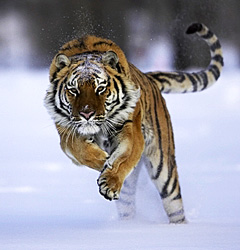
It is estimated the wild population of Siberian tigers at around 350-450 tigers.

Almost all wild Siberian tigers live the Southeast corner of Russia in the Sikhote-Alin mountain range east of the Amur River. Their former range included northeastern China and the Korean Peninsula, and as far west as Mongolia. They are the largest of the tiger species and can grow up to 13 feet in length and weigh up to 700 lbs.

The Siberian –or Amur- tiger is considered a critically endangered species with the primary threats to its' survival in the wild being poaching and habitat loss from intensive logging and development.

Tigers are most commonly poached for their fur and for their body parts used in Traditional Chinese Medicine. It is estimated that in 1991 alone, one-third of the Siberian tiger population was killed to meet the demand for their bones and other parts used in this practice. This even though the practice is now unlawful in China.

In 1993 the State Council of the People's Republic of China issued a notice declaring the use of tiger bone for medicinal purposes to be illegal. The Chinese government encouraged the Ministry of Public Health and the pharmaceutical companies to seek substitute medicines for tiger parts.

However, because it is such a lucrative trade –a single tiger can bring up to $50k on the International market- the practice is still flourishing.

The other vital concern for the survival of the Siberian tiger in the wild is habitat loss.

Research has demonstrated the Siberian tigers require vast forest landscapes to survive. However logging, both legal and illegal is threatening the tigers home by fragmenting their habitat thereby isolating them from each other. In addition, the continuous creation of new logging roads provide poachers with access to formerly remote areas.

So in essence, for the Siberian tiger to survive in the wild, and no longer be considered and endangered species, two things must happen. First, habitat encroachment must stop and secondly, the thousands of years old tradition of using tiger parts for medicinal purposes must also end.

These are formidable requirements.